Media Ready with Mo
Find your voice. Tell your story. Make an impact.
Hands-on media training for teens and young adults—created for high schools, colleges, and church youth programs. Help your students prepare for interviews, speak with clarity, create purposeful content, and represent their communities with confidence. Led by ShaDonna "Mo" McPhaul, this practical program combines guided activities,
real-world examples, and supportive feedback.
Media Ready with Mo
Find your voice. Tell your story. Make an impact.
Hands-on media training for teens and young adults—created for high schools, colleges, and church youth programs. Help your students prepare for interviews, speak with clarity, create purposeful content, and represent their communities with confidence. Led by ShaDonna "Mo" McPhaul, this practical program combines guided activities,
real-world examples, and supportive feedback.
Skills for the microphone and
the moments that matter
A school announcement. A campus interview. A service-project spotlight. An introduction
to a future employer. Media Ready with Mo gives young people a place to practice
communicating with purpose.
Speak clearly
Organize ideas and deliver a focused introduction.
Tell meaningful stories
Explain what matters and why an audience should care.
Interview with intention
Ask thoughtful questions, listen, and respond.
Create responsibly
Check information, respect
boundaries, and protect privacy.
Explore possibilities
Discover roles in hosting, production, journalism, public relations, and digital media.
Skills for the
microphone and the moments that matter
A school announcement. A campus interview. A service-project spotlight.
An introduction to a future employer. Media Ready with Mo gives young people a place to practice communicating with purpose.
Speak clearly
Organize ideas and deliver a focused introduction.
Tell meaningful stories
Explain what matters and why an audience should care.
Interview with intention
Ask thoughtful questions, listen, and respond.
Create responsibly
Check information, respect
boundaries, and protect privacy.
Explore possibilities
Discover roles in hosting, production, journalism, public relations, and digital media.
Choose the experience that fits
your students
01
For high schools
Teen Media Training supports student
voice, leadership, school media, and
career exploration. Activities can
include club interviews, school-news
introductions, and service-project
stories. Designed primarily for ages
14–18.
02
For colleges
College & Young Adult Media Training connects campus storytelling with professional communication. Students
can practice campus interviews,
student organization pitches, and introductions for networking or career opportunities. Designed primarily for
ages 18–24.
03
For churches
Bring purposeful media practice to
your youth group or young-adult
ministry. Explore announcements,
service storytelling, and responsible
media participation. Optional faith-
based activities can be selected with
your ministry leader.
Choose the experience that fits your students
01
For high schools
Teen Media Training supports student
voice, leadership, school media, and
career exploration. Activities can
include club interviews, school-news
introductions, and service-project
stories. Designed primarily for ages
14–18.
02
For colleges
College & Young Adult Media Training connects campus storytelling with professional communication. Students
can practice campus interviews,
student organization pitches, and introductions for networking or career opportunities. Designed primarily for
ages 18–24.
03
For churches
Bring purposeful media practice to
your youth group or young-adult
ministry. Explore announcements,
service storytelling, and responsible
media participation. Optional faith-
based activities can be selected with
your ministry leader.
Start with a workshop. Build
toward a full course.
Choose a format that fits your group's goals and schedule. Activities are adapted to
the audience and agreed program scope.
90-minute introductory workshop
Mo on the Mic
A hands-on introduction to finding your voice and getting
comfortable with interviews. Students draft an introduction,
practice with a partner, and learn basic media boundaries.
Designed for up to 25 participants.
Includes guided practice and an interview checklist.
Students leave with a revised introduction and a next step for practice.
Half-day lab
Media Ready with Mo
A three-hour experience with more room to practice. Students explore interview technique, camera and microphone presence, and how to organize a clear message.
Designed for up to 20 participants.
Includes a short practice interview and starter message map.
Suitable for a focused school, campus, or youth- program session.
Full training course
Media Ready with Mo
Eight 90-minute sessions bring together seven learning modules and a final mock interview. Students build their materials step by step and receive feedback to guide their progress.
12 hours of instruction; designed for up to 20 participants.
Includes student worksheets, a starter portfolio, and capstone feedback.
Completion certificate available for students meeting the participation and portfolio requirements.
Put the skills into practice
Optional extension
Ask about a separately scoped student media-team project or supervised event-coverage experience. Project goals, equipment, editing, permissions, and final deliverables are agreed in advance.
Program investment
Request a customized quote based on your format, group size, location, and production needs. Interested in helping a group access training? Ask about sponsoring a workshop or supporting participant seats.
Start with a workshop. Build
toward a full course.
Choose a format that fits your group's goals and schedule. Activities are adapted to the audience and agreed program scope.
90-minute introductory workshop
Mo on the Mic
A hands-on introduction to finding your voice and getting
comfortable with interviews. Students draft an introduction,
practice with a partner, and learn basic media boundaries.
Designed for up to 25 participants.
Includes guided practice and an interview checklist.
Students leave with a revised introduction and a next step for practice.
Half-day lab
Media Ready with Mo
A three-hour experience with more room to practice. Students explore interview technique, camera and microphone presence, and how to organize a clear message.
Designed for up to 20 participants.
Includes a short practice interview and starter message map.
Suitable for a focused school, campus, or youth- program session.
Full training course
Media Ready with Mo
Eight 90-minute sessions bring together seven learning modules and a final mock interview. Students build their materials step by step and receive feedback to guide their progress.
12 hours of instruction; designed for up to 20 participants.
Includes student worksheets, a starter portfolio, and capstone feedback.
Completion certificate available for students meeting the participation and portfolio requirements.
Put the skills into practice
Optional extension
Ask about a separately scoped student media-team project or supervised event-coverage experience. Project goals, equipment, editing, permissions, and final deliverables are agreed in advance.
Program investment
Request a customized quote based on your format, group size, location, and production needs. Interested in helping a group access training? Ask about sponsoring a workshop or supporting participant seats.
What the full course covers
The course concludes with a supported mock interview, feedback, and a personal
practice plan.
What the full course covers
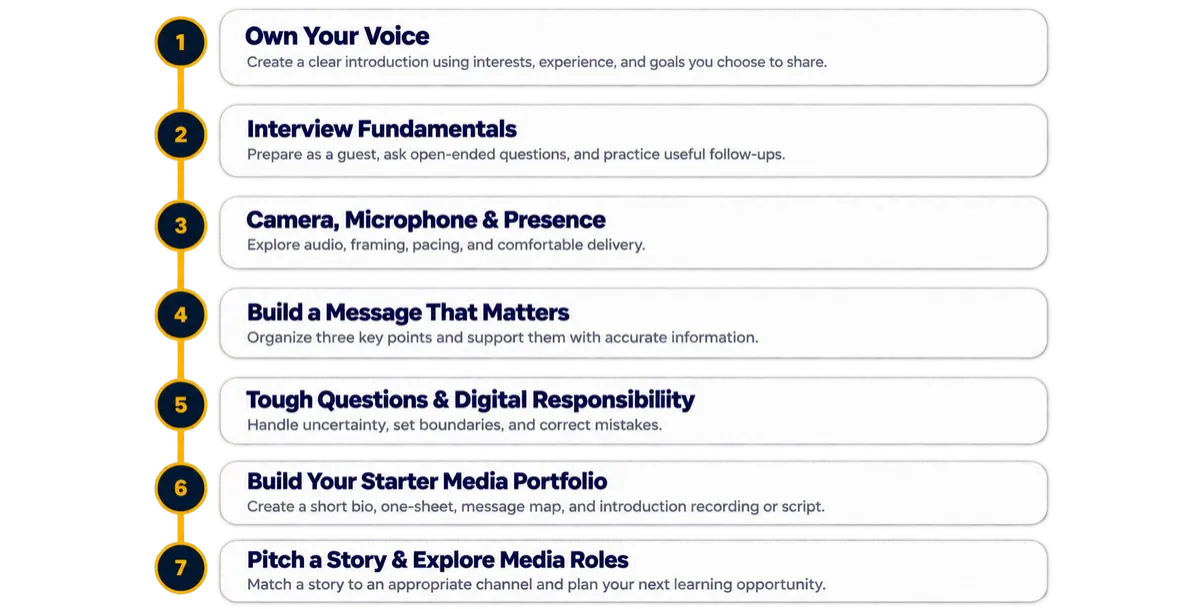
The course concludes with a supported mock interview, feedback, and a personal practice plan.
What the full course covers
The course concludes with a supported mock interview, feedback, and a personal practice plan.
Leave with something you can
use
Full-course participants build:
A 30–60-second introduction.
A pre-interview checklist and three-message map.
A plan for responding to difficult or private questions.
A short bio and student one-sheet.
An introduction recording or script.
A story-pitch draft and final mock interview.
A 30-day plan to keep practicing.
Short workshops include a smaller set of activities and materials matched to their length.
Leave with something you can
use
Full-course participants build:
A 30–60-second introduction.
A pre-interview checklist and three- message map.
A plan for responding to difficult or private questions.
A short bio and student one-sheet.
An introduction recording or script.
A story-pitch draft and final mock interview.
A 30-day plan to keep practicing.
Short workshops include a smaller set of activities and materials matched to their length.
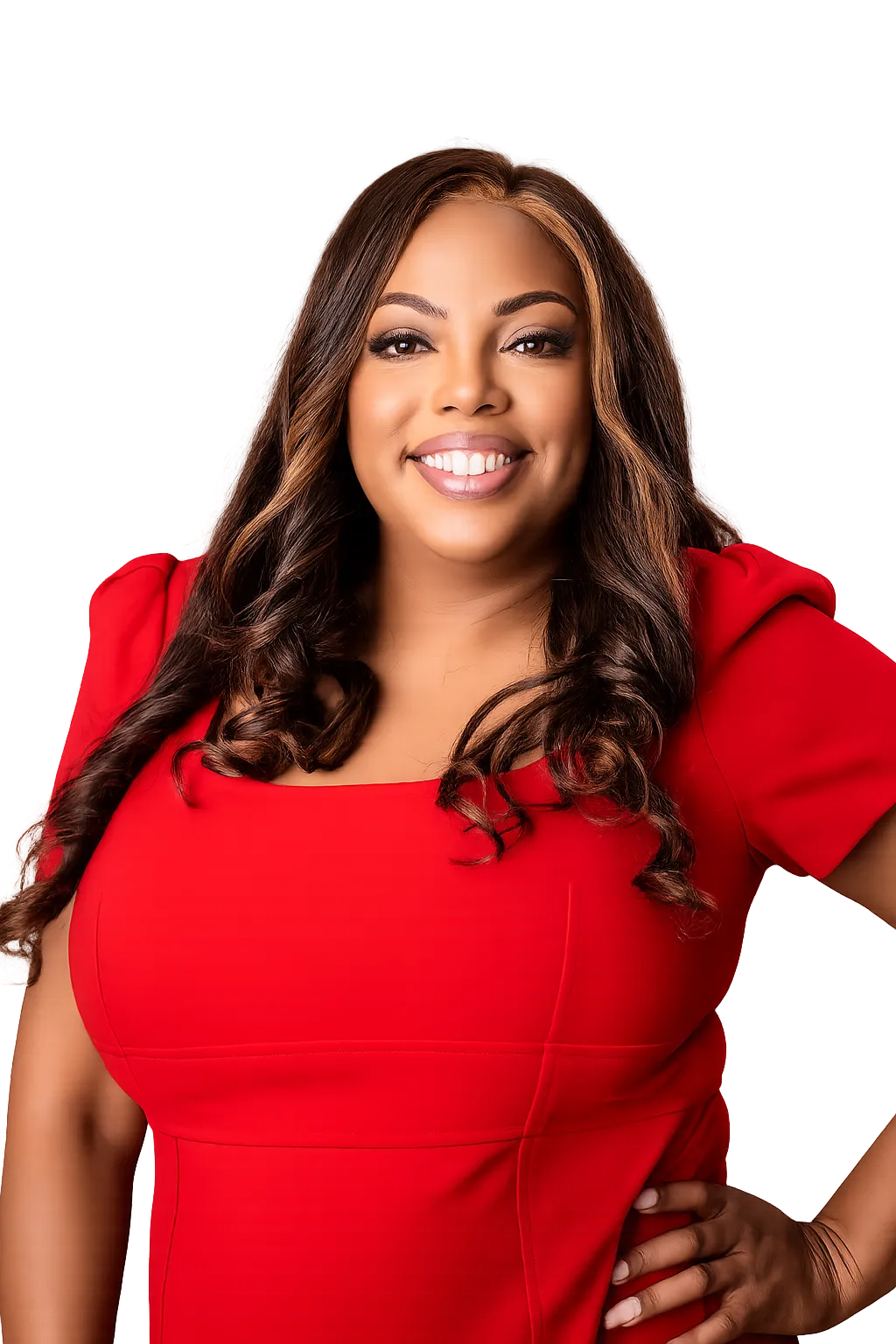
Meet your facilitator: ShaDonna "Mo" McPhaul
ShaDonna "Mo" McPhaul is a retired U.S. Air Force veteran, media host, public relations professional, and founder of The Mo You Know and MYK Impact Network. Her experience includes interviewing, event coverage, storytelling, and connecting communities through media.
Through The Mo You Know Media Academy, Mo brings that practical experience into a supportive learning environment where young people can practice, receive feedback, and discover how their voices can make an impact.
"Credibility is king and visibility is queen."
— ShaDonna "Mo" McPhaul
Frequently asked questions
Do participants need media experience?
No. The program welcomes beginners and gives participants structured opportunities to practice. Activities can be adjusted to the group's experience level.
Do students need expensive equipment or social media accounts?
No personal social media account or equipment purchase is required. Shared devices can be used, and device-free alternatives are available. Equipment arrangements are confirmed with the host before training.
Does every participant have to appear on camera?
No. Audio-only, live unrecorded, written, or behind-the-scenes options can support the same learning goals. Public posting is not required to complete the course.
How do you handle recording and student privacy?
We coordinate with the host organization on supervision, recording permissions, and access to student work. Classroom recording and public use are handled separately. For minors, we use the host's parent or guardian permission process and respect the student's willingness to participate.
Can the program be adapted for our organization?
Yes. School, college, and church activities use the same core communication skills with examples suited to each setting. Faith-specific activities are optional for church groups; school programming uses secular examples. Tell us about your goals and accessibility needs during planning.
What does our organization provide?
A staff coordinator, appropriate supervision, a suitable learning space, and agreed equipment arrangements. The host also coordinates enrollment, accessibility arrangements, and required permissions. We confirm responsibilities before booking.
Is there a certificate?
The full course offers a completion certificate for students meeting the participation and portfolio requirements. It is a program completion certificate, not an accredited credential or academic credit.
Will students be featured on MYK Impact Network?
Participation does not guarantee a feature, internship, employment, or media placement. Any possible feature is considered separately and requires the appropriate permissions.
How do we book?
Complete the program inquiry form. We will review your goals, discuss a suitable format, and prepare a proposed scope and quote. Dates are confirmed through the booking process.
Bring Media Ready with Mo to
your organization
Tell us about your students, your goals, and the experience you would like to create.
Let's plan a program that helps your group find its voice and use it with purpose.
Bring Media Ready with Mo to
your organization
Tell us about your students, your goals, and the experience you would like to create.
Let's plan a program that helps your group find its voice and use it with purpose.
The Mo You Know Media Academy | Media Ready with Mo
A training offering from The Mo You Know Marketing & Media Consulting Services, LLC
Find your voice. Tell your story. Make an impact.
The Mo You Know Media Academy | Media Ready with Mo
A training offering from The Mo You Know Marketing & Media
Consulting Services, LLC
Find your voice. Tell your story. Make an impact.